Single-Player Mode
I used Claude (Anthropic) to help research and write this piece. The analysis and perspective are mine, but Claude did the heavy lifting on synthesizing industry data and making my draft readable.
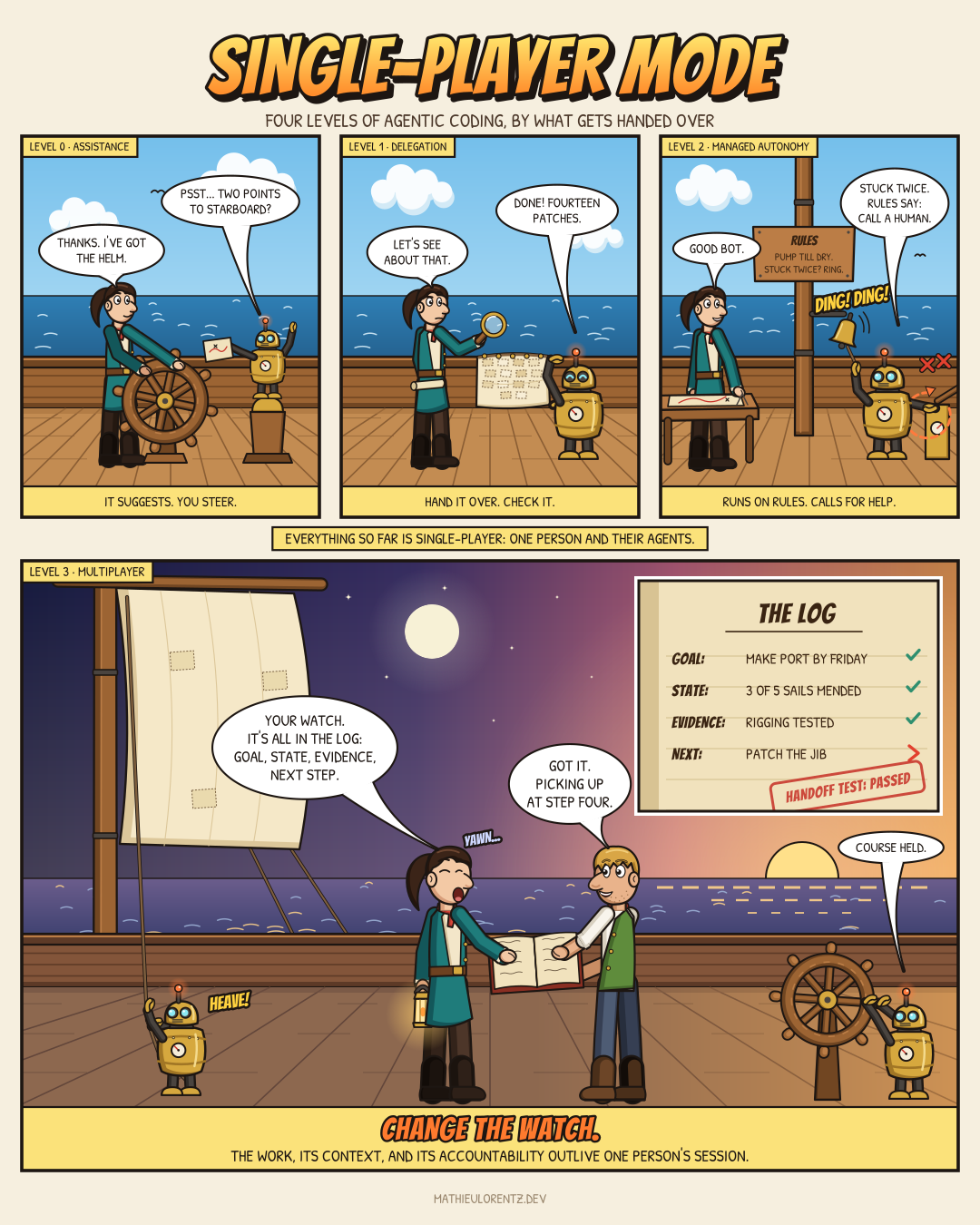
On an offshore passage the boat never stops, but the crew has to sleep. Every few hours the watch changes. The outgoing watch briefs the incoming one on course, sail plan, weather, and traffic, and the log holds the rest. A single-handed sailor can be brilliant. A crew is only as good as its handovers.
The usual AI adoption dashboard counts sailors, not crews: licenses issued, prompts sent, tokens burned. Measure instead what actually gets handed over. I count four levels.
Level 0 is assistance: the agent (an AI tool that can carry out multi-step work) suggests, you steer. Level 1 is delegation: you hand over a bounded task and check what comes back. Level 2 is managed autonomy: a repeatable workflow with acceptance criteria, stop rules (when the agent must halt and ask), and an escalation path, running without a prompt at every step. Level 3 is multiplayer: the work, its context, and its accountability outlive one person’s session.
The single-player game has found its shape. In Anthropic’s study of roughly 400,000 sessions with Claude Code, its coding agent, people made about 70 percent of the planning decisions and the agent about 80 percent of the execution decisions. The machine increasingly does the work. The plan still lives with one person. Addy Osmani’s six autonomy levels chart how far that person can push from there, up to agents that manage other agents.
Multiplayer is another matter. In CooperBench, a benchmark from Stanford and SAP, two coding agents building separate features in the same codebase succeeded about 30 percent less often on average than one agent building both. For the leading models, it was about half as often. Messages were vague or late, commitments slipped, and agents misjudged what their partner was doing. The paper’s title says it plainly: coding agents cannot be your teammates yet. One fix the researchers point to is verifiable shared state: a record of where the work stands that a partner can check. Sailors call it the log.
So for now the crew is human. Two people inheriting each other’s agent work can fail the same way two agents do, and for the same reason: no log they can check. The question shifts from how far one engineer can delegate to whether anyone else can pick up the work.
The failure is easy to picture. The agent did good work, but its context lives in one person’s session history, its rules in their personal settings, and its access in their credentials. When that person is out, a colleague can read the code but not the reasoning.
Three things belong on a leader’s agenda before next year’s plans lock.
Count levels, not licenses. Sample last month’s work: how much was assisted, delegated, run as a workflow, or shared? The goal is not Level 3 everywhere. A strong team still drops to Level 0 when the problem is new, and some work should stay there by design.
Make one workflow run without its author. If it only works with its creator watching, it is a power user’s setup, not a capability. Give it a named owner and its own access, not the author’s personal keys. Otherwise it leaves when they do, or worse, keeps running after they have gone.
Run the handoff test. If the engineer who started the agent’s work is out tomorrow, can a colleague see its goal, its state, its evidence, and the next step, in the ticket rather than in someone’s terminal? And do they know who owns it now? In a regulated firm, work nobody else can pick up is work nobody else can audit.
In The Rigor Has to Go Somewhere, I wrote about cognitive debt: the knowledge a team loses when it offloads its thinking to AI. A workflow only its author understands is the same debt, held by one person. Agents taught your engineers to sail single-handed. Now your firm has to learn to change the watch.
References
- Zoe Hitzig, Maxim Massenkoff, Eva Lyubich, Shaoyi Zhang, Ryan Heller, and Peter McCrory, “Agentic coding and persistent returns to expertise,” Anthropic (June 16, 2026); source of the roughly 400,000 interactive sessions from about 235,000 people (October 2025 to April 2026) and the 70 percent planning, 80 percent execution split
- Addy Osmani, “Agentic Autonomy Levels” (July 2, 2026); six levels (0 to 5) across two axes, agency and orchestration, from assistance to a manager agent dispatching worker agents
- Arpandeep Khatua, Hao Zhu, et al., “CooperBench: Why Coding Agents Cannot be Your Teammates Yet,” Stanford University and SAP Labs US, arXiv (January 2026); source of the 30 percent average drop in success against a single agent doing both tasks (about half for the leading models), the three coordination failures (communication, commitment, expectation), and the call for “verifiable shared state”