The Flood and the Floor
I used Claude (Anthropic) to help research and write this piece. The analysis and perspective are mine, but Claude did the heavy lifting on synthesizing industry data and making my draft readable.
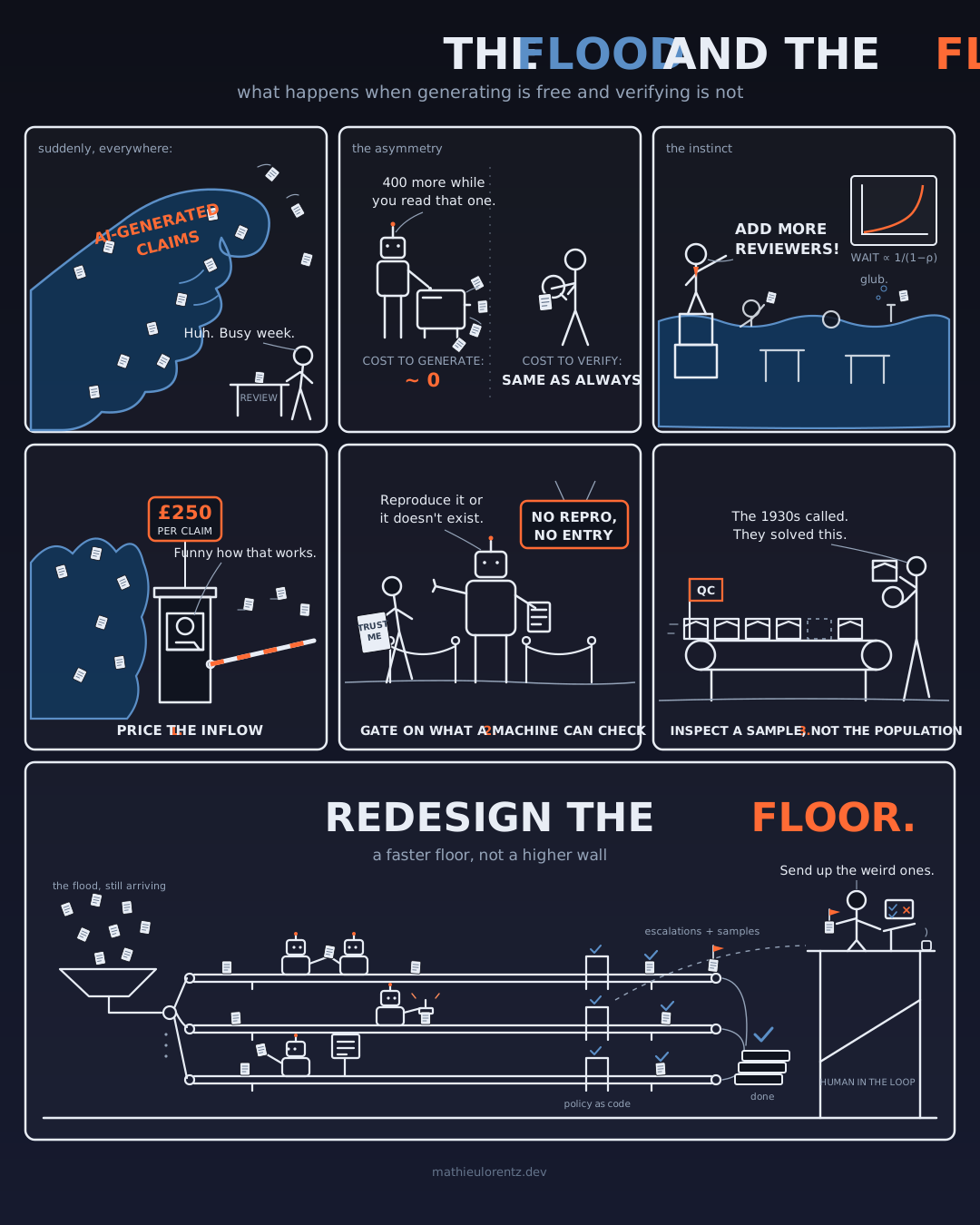
In Britain, employment tribunal hearings are now being scheduled into 2028. The backlog of open claims rose 55 percent in a single year. Applications for emergency injunctions rose more than a hundredfold. Nobody removed any judges. Claimants got AI.
There is a name for this. Chris Schmitz, a PhD student at Berlin’s Centre for Digital Governance, called it agentic flooding, and Tom Loosemore put the term in front of government: what happens when AI makes generating a claim nearly free while the system receiving it still verifies at human speed.
It is not only a government problem. In January, Daniel Stenberg shut down the curl bug bounty. Curl is the open source data transfer tool running inside most connected devices on earth, and for years the bounty paid researchers who reported genuine security flaws in it. Then AI made writing a convincing vulnerability report nearly free. Submissions climbed; real findings did not. The share that turned out to be genuine fell from about one in six to fewer than one in twenty. Seven volunteers spent their days disproving bugs that had never existed.
Every engineering leader knows this shape. Faros AI’s telemetry across 1,255 teams found that high AI adoption produced 98 percent more merged pull requests, 91 percent longer review times, and no improvement at all in delivery metrics. We automated the generating and left the verifying where it was.
The instinct is to add reviewers. Queueing theory says that is a losing move. Waiting time scales with one over one minus utilization, so a queue already running hot does not degrade gracefully when arrivals rise. It collapses.
Three things work better.
Price the inflow. Curl removed the prize money and its valid-report rate recovered to 15 percent. When the Financial Ombudsman Service charged claims firms £250 a case, quarterly cases from professional representatives fell from 37,100 to 4,300.
Gate on something a machine can check. Stenberg’s rule is that you do not report a bug you cannot reproduce, which puts the burden of proof back on the sender. The enterprise version is policy as code, spec-driven pipelines, and compliant paths that are the only paths.
Inspect a sample, not the population. Manufacturing settled this in the 1930s. Exhaustive inspection was always the expensive way to buy quality.
None of it is sufficient. Curl’s report volume doubled even after the money went away, and in July the project stopped accepting reports altogether for a month. Some of the flood is also legitimate demand that friction used to suppress. A worker who could never afford a lawyer can now file a real claim. The answer to that is a faster floor, not a higher wall.
Over the past few months, the pattern has held: AI accelerates execution and exposes the quality of everything underneath. The flood is what that looks like when the thing underneath is a queue nobody redesigned. Adding reviewers only staffs the old factory floor.
Redesign the floor.
References
- The Economist, “AI-armed litigants are overwhelming Britain’s employment tribunals” (August 2026)
- Ministry of Justice, “Tribunal statistics quarterly”; see also the Presidential Guidance of Judges Barry Clarke and Susan Walker (June 2026)
- Tom Loosemore, “Flood warning: How citizens’ AI agents will swamp public services,” Computer Weekly (April 2026), on Chris Schmitz’s coinage of “agentic flooding”
- Daniel Stenberg, “The end of the curl bug-bounty” (January 2026); curl, “Vulnerability Disclosure Policy”
- Faros AI, “The AI Productivity Paradox” (2025)
- Legal Futures, “Case fees cause collapse in number of law firm complaints to FOS” (November 2025)